Thursday, 11 April 2013

Pulley Systems - Maia Brausch

Pulley Systems


Pulley systems are used in the real world to lift large masses onto tall heights. I have seen the workers repairing the roof of a house and using the pulley system to lift their tools and materials to the roof.

The pulley system is made up of of one or more pulleys and a rope or a cable. The number of pulleys used may be more or less, so the easier it is to lift the object that is being lifted.

No matter how easy it is to use the pulley system, the system itself is not very easy to use because of the force of friction. For example, one has to pull two meters of rope of cable through the pulleys just to lift an object one metre.

Clothesline pulley

Ancient Egyptian Pulley System

The ancient Egyptian wooden four lobe pinion pulley was used to construct the Giza Pyramids in around 2600 BC.

This pulley surrounds its load and works with a mechanical advantage of 2.8 (MA=2.8) on the lever principle. When hoisted, the pulley with load rotates and climbs stepped structures with engagements of pulley lobes with steps.

This is earliest machine known using "rack and pinion" mechanical technology.


Ezekiel's vision

Ezekiel’s vision is about some ideas about alien spacecraft and the planets motion of our solar system.

What great structures have been put up in the Middle East where thousands of workers were employed and who would return home and tell others what they saw?

Ezekiel’s writings started in Babylon around 590 BC and his descriptions are very specific in many instances. The “wheel within wheel” machines are “high and awesome having four rims with eyes all around.”

Ramps are not mentioned in any documents describing how the Giza Pyramid were made, so why ramp theories exist today is a bigger mystery than the Pyramid itself.
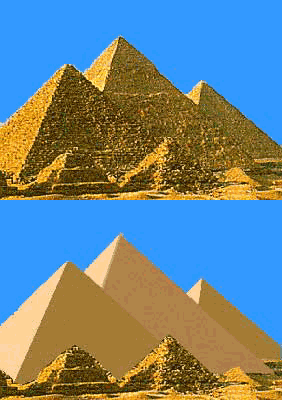


By Maia Brausch (with the help of Google)

Team New Zealand - Pulleys

Team New Zealand


On a sailing boat pulleys are used with the sails.

 
The ropes go through pulleys and keep the sails tight. 
 

The wind then blows against the sails to make the boat go fast.

 
The pulleys make it easier to pull the ropes tight.
 
 
Go Team New Zealand

By Daniel Taylor
 

Egyptain Pulleys

Did you know that a pulley is used nearly every second!

The pulley is a wheel with two raised edges for the rope to fit through, you can use it in different ways, lifting heavy loads, transmit power and also apply forces!

The Ancient Egyptians used the pulley to make pyramids that normal people could carry, the stone blocks were over 10 tons (that's a lot)!


By Jeffrey Lin

Egyptians by Alice


My pulley story is about one of the tools the Egyptians used to build the Pyramids.


It is called the Four Lobe Pinion Pulley. 


It was used for getting heavy stone blocks up to the top of the pyramids.

The four lobes are the cradles, these were tied to the sides of the heavy stone blocks.

This turned the stone block into a small gear.

The big gear was the steps on the pyramid.  
 
They then got really strong rope and some really strong men they put it over their shoulder and they pulled the pulley up to the top of the pyramid.

The steps on the pyramid lined up with the lobes on the block to stop it from wobbling and falling off. A bit like gears.


The other way of doing it was to turn the block into a cylinder.

When you turned the block into a cylinder you needed a ramp instead of steps.


My pulley is the same as the one invented by Archimedes except it does not have a fixed pulley. The cylinder is the pulley and the man is the energy to move it, the point at the top is the fixed point. Because half of the weigh of the block is on each rope the weigh on the rope is halved.

By Alice
 

Wednesday, 10 April 2013

Pulleys

A pulley is a kind of wheel with two raised edges that a rope runs along. You can use pulleys in different way, to make it easier to pull a rope, to change the direction of the force, or to get more mechanical advantage and lift something heavier than you could usually lift by yourself.

 Clothesline pulley
This clothesline uses a fixed pulley.

A fixed pulley is attached to a hook or a wall and doesn't move. It doesn't change the force needed to lift something but can change the direction of the force, that is you can pull down to lift something up.
A moveable pulley gives you a mechanical advantage. This means you can pull with less force for longer distance to get the same work done. This means you can lift things that would usually be too heavy to lift without a pulley.

By Emily

Tuesday, 9 April 2013

Archimedes (pulleys)

We use pulleys almost everyday!

Archimedes was a great mathematician and engineer who was born 287 years BC in Syracuse, Sicily. He is credited with coming up with the idea and the use of modern day maths equations and the way things like levers pumps and pulleys work. Archimedes had wrote in a letter to King Hieron that he could move any weight with pulley, he boasted that given enough pulleys he could move the whole world! The king challenged him to move a big ship that would take lots of men and a great amount of work to move the sea. On the planned day, the ship was loaded with lots of passengers and lots of cargo, and the king watched to see if Archimedes could do what he said he could do. Archimedes knew he could improve his mechanical advantage for lifting or moving objects using pulleys.
A pulley moves a force along a rope without changing how big it is. When engineers work with pulleys they often make sure that the rope of the pulley moves smooth and evenly, without catching. These systems are known simply as "pulley systems" because they use the same rope through the whole system, if the pulleys were attached with more than one rope the system would be a "complex system".

By Katie

Roman water wells

The people of Ancient Rome used pulleys to pull water from deep under the ground.
Evey body needs water to survive.
To use this pulley they would have turned a handle which made the rope pull the bucket up.
They then empty the bucket before lowering again. This is a very simple and old system that works very well. It would have looked like this.

By Renee  Booth
 
Copyright 2009 Karearea Kids